Prayerful Interiority & Perspective-Taking

Purposes
1. To appreciate the interconnected spiritual practices of self-awareness and attentive listening to others;
2. To inspire a more creative and self-aware perspective-taking, both personally and in conversations with colleagues.
From Unconscious to Conscious
The capacity to pause and take perspective is essential to Christian leadership. It allows us to pay attention—individually and communally. Without it, we get stuck.
For example, I once facilitated a group for two days before realizing how the dynamics were draining me. One person wouldn’t speak unless called upon. Another flooded the space with words, seemingly to avoid change. The rest struggled to build on one another’s ideas. Although I could have muscled through, something was nudging me to speak up because folks were not yet aware that the group was struggling to communicate.
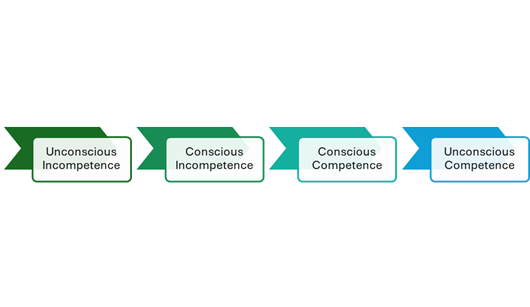
The Conscious Competence framework, attributed to Noel Burch of Gordon Training International (1970s), provides a helpful lens for this situation. We begin unaware of both our lack of skill and the skill itself (Unconscious Incompetence). We then become aware of our limitations (Conscious Incompetence). With practice, we learn to apply new skills intentionally (Conscious Competence). Eventually, they may become second nature (Unconscious Competence). What would it take to raise our awareness and strengthen communication?
Individual Perspective: Thinking, Feeling, and Bodily Sensations
My first clue to increased awareness in the situation described above was noticing how tired and disconnected I felt. Then I realized my shoulders were tight, my brow was furrowed, and my thoughts were spinning—analyzing and judging in ways that weren’t helpful.
All this is the stuff of human experience—our thinking, feeling, and bodily sensations.
We simply can’t escape the realities happening along with and underneath whatever good we are trying to accomplish on the surface. It’s also true that we wouldn’t want to escape these dimensions of human experience. After all, Christianity is an incarnational tradition—God has a human face in Christ and we experience and respond to God through our humanity. Think of the Eucharist in which God’s grace is made tangible through the mysteries of the elements combined with the Word.
It is, in fact, possible to plow through and exercise ministry with Unconscious Incompetence, ignoring what we are thinking, feeling, and sensing in our bodies. However, it is better in the long term for us to become more honest with ourselves about what we do and do not know (Conscious Incompetence). When we take the opportunity to ask, “What’s going on in me?,” that increased self-awareness allows us to show up more fully and practice re-engaging the situation more skillfully (Conscious Competence). In this case, I used my individual perspective to find the courage to speak up.
Communal Perspective: Strengths-based Conversations
Self-awareness alone wasn’t enough; the group needed to name its dynamics together. We paused and talked. One participant realized they had been holding back (Conscious Incompetence), while the over-talker seemed surprised to hear how they were impacting others (Unconscious Incompetence). Simply having that conversation moved us toward healthier patterns (Conscious Competence).
We affirmed our shared desire to value every voice, which led to a meaningful conversation about what each member was bringing to and needing from the community. We clarified expectations, creating room for mutual support.
Where Taking Perspectives Breaks Down
The following days weren’t without challenges, but we navigated two common pitfalls: a lack of interiority and a lack of respect for others’ vantage points.
Prayerful interiority requires noticing our own thoughts, feelings, and sensations. This isn’t just about moderating behavior—it’s about listening for the Spirit. When we ignore or suppress these movements, we lose touch with how God may be speaking through them.
Perspective-taking also falters when we give lip service to others’ gifts but cling to our own biases. Are we truly listening as though this person is gifted by God? Are we curious enough to let their words challenge and shape our own thinking?
Return to the Fundamentals
When conversations stall, return to a prayerful interiority check.
What’s happening in your mind, heart, and body?
What are these responses trying to show you?
Once grounded, re-engage with Conscious Competence. If appreciating another person is still difficult, remember: “Any leader can hold only about 10% of the necessary data.” Or turn to Scripture that reminds you this person is “fearfully and wonderfully made.” Any slice of humble pie will do.
With practice, prayerful interiority and strengths-based conversations can become second nature (our shared Unconscious Competence). That’s the kind of rich dynamic that takes a few more workshops together!
For Discussion
Stimulus-Response
Ministry Application
What is the ministry situation you’re facing that is most on your mind?THINKING/FEELING/BODILY SENSATION
What are you experiencing personally in response to this situation? What wisdom might the Spirit be offering you and others through these experiencesStrengths-based Conversations
What perspectives are others bringing to your sense of this situation? What do you most appreciate?RESPONSE
How is the conversation between your personal experience and the communal perspective expanded the options you have for a response?
PRAYER | God of the Incarnation, through Christ you redeem the embodied human experience. Help us listen to the wisdom you speak through our own thinking, feeling, and bodily sensations. Expand our perspectives through the witness of other members of the community. Amen.
Sam Rahberg is a spiritual director, CliftonStrengths coach, and founder of STRENGTHSFORWARD. Learn more at www.samuelrahberg.com.